Ajahun Na Aaye Shyam
q1 `90o-Composer : Unknown. Though there's a similarly worded composition in Nand by [[Vilayat Hussain Khan -Pranpiya]].
Tags: #classicalweekly
Lyrics
Ajahu na hi aaye
Aaye piya more
Naina hamaare tarasaye jaaye
Jabse gaye mori
Sudhahu naleenii
kabahu nahi darasaye jaaye
Thaan at 10:31
Teases the motif in the thaan .
G M P D P P S ....
GM P D P P N ... S... D... N..P
GM P m P N...
Draft
For the quick listeners, Listen from 2:00 to 4:15. Try singing along to the lyrics to see how it's performed. This is a good skeleton of the Indian classical song, and a good primer for a Khayal - persian for "imagination", usually realized as romantic poetry.
The unusual groove is because the composition is set to a 10-beat pattern. Musicians - try and count it.
This composition is special to me. First, and most importantly, I learned both "Raag Nand" (Raag roughly translates to mood/tone and "Nand" would be similar to "Dorian/Ionian") and this version of it from my teacher Nachiketa Sharma.
Second, this is a good template for a short-medium classical performance. One that I assume must have been thoughtfully put together by Pt D V Paluskar for a live radio broadcast. DVP was child prodigy in music, a classicalist who song for the common man. An act which was considered rebellious by his contemporaries.
This was recorded somewhere between 1945 and 1955 (before his untimely passing).
Lyrics
"Ajahu na hi aaye
Aaye piya more
Naina hamaare tarasaye jaaye
Jabse gaye mori
Sudhahu naleenii
kabahu nahi darasaye jaaye"
Roughly translates to:
"You did not show up today,
my love,
my eyes long for you"
"Since you been gone :)
I have lost my senses
I never see you anymore" (I'm not sure about the last line. Please send corrections.)
Breakdown
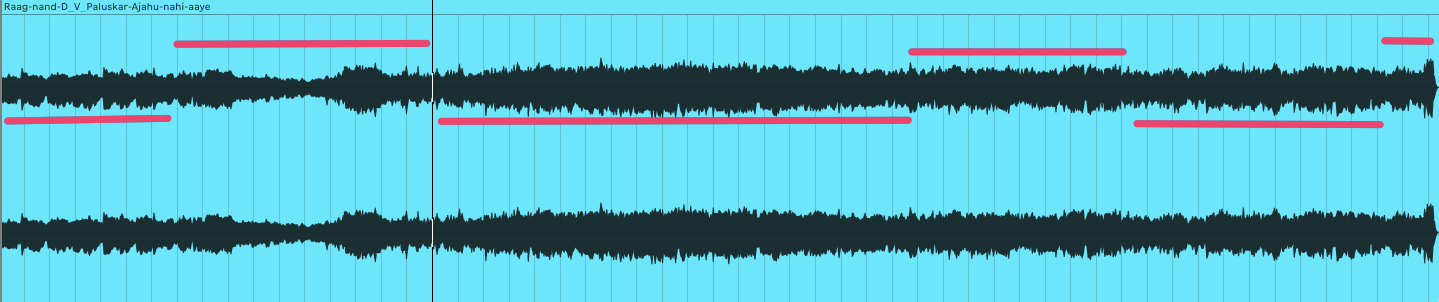
Structure of the song
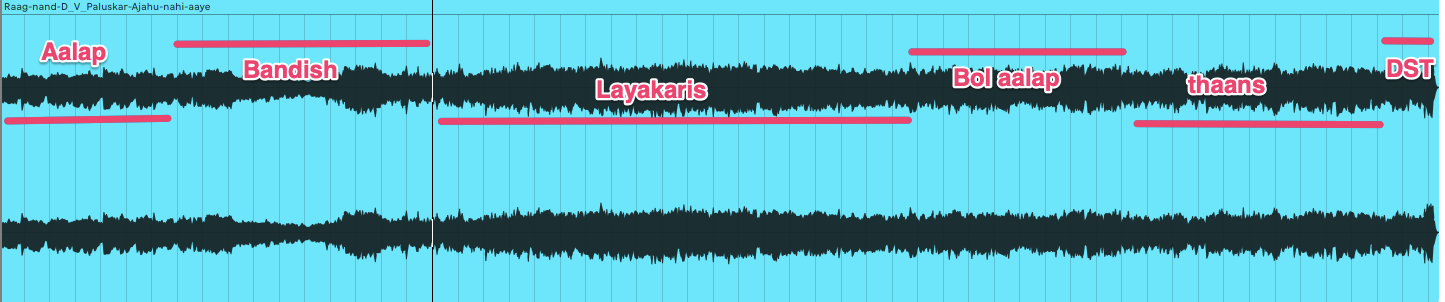
The [[aalap]] (0:00 to 2:00), or the "opening section" of classical performance is an improv by the singer/lead to "present" the Raag.
Grammar
Indian music theory can be explained using Western (equal temperament) scale. Pitch (key) of the song is what is important. While this song is set to C#, to make the breakdown easy, I'm going to assume middle C to be the pitch, making it the relative "Sa", so you can follow/play/sing along.
- Raag Nand's notes starting at C are all Major keys on the piano on the ascending, but touching the F# on the way down. It's considered a "Vakra raag"(atypical progression) . In that, traversing the notes in the raag is not linear. This is where the intricacies of Indian classical system begins :)
- Only 6 notes are used in the ascent (skipping D, F#)
- F# is used very sparingly, only in the descent
- You're only allowed 3 notes in the ascent from G to upper C'. [G .. B..C'] is popular and occasionally [G.. A... C] but never G .. A .. B .. C
- Descending to upper C usually entails skipping it entirely. D' .. B .. C is acceptable.
- G...D and the meend (glide from G to D) is characteristic of the family of Raags this belongs to.
- If you're improvising you are allowed to rest/converge on C or G and equivalently, musicians also rest on E.
That's it. Those are the rules. Here's the nand scale in sheet music form.
Have fun singing/playing Nand. I'll share a few more compositions in Nand in the coming weeks.
Kalyan Thaat Raags - Hamir (uttaranga pradhan - work in the upper octaves)